
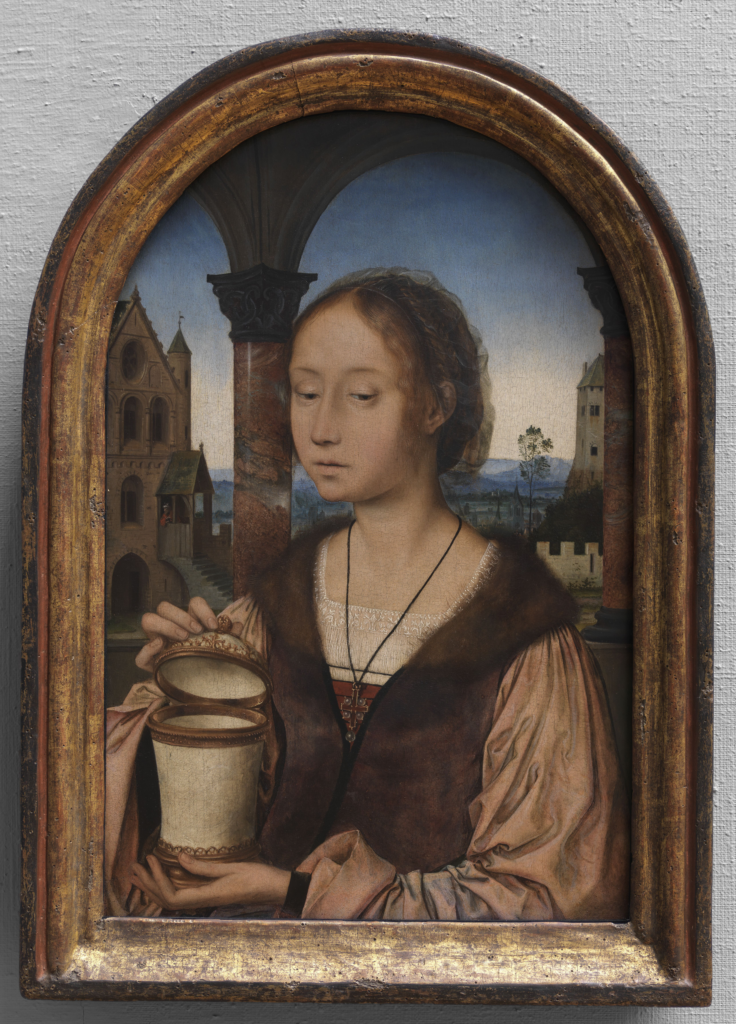
Freed from her demons by Jesus, Mary of Magdala became one of his most ardent followers. She was there when he was crucified, and on Easter morning she mistook the risen Jesus for the gardener, … and then became the apostola apostolorum — the apostle of the apostles. That is all the New Testament (f)actually says about the woman Mary of Magdala, The Magdalene.
Everything else — the jar of perfume (her attribute), the prostitute, the penitent, the voyage to Marseille, the cave, her long hair — is the result of a remarkably creative exercise in biblical and extra-biblical fusion, carried out over several centuries by the Western Church. The process began modestly enough. In the sixth century, in a sermon, Gregory the Great identified three distinct women from the Gospels as one and the same person:
1. Mary of Magdala,
2. An anonymous woman, ‘a sinner’ who washed Jesus’ feet.
3. Mary of Bethany, the sister of Lazarus and Martha.
These three, merged into one, became La Madeleine. The Eastern Church never accepted this conflation; the West did, enthusiastically. The fusion of the three women was “a stroke of genius of the Latin Fathers” (Georges Duby), because the composite portrait that emerged is so rich that she became one of the most influential female figures in European history. Later a fourth figure joined the composite: Mary of Egypt, a penitent desert hermit whose legend — complete with levitation, angelic communion — merged so smoothly with the rest that painters and sculptors found it impossible to disentangle them (and did not want to either, I suppose. Too enticing). When Jacques Lefèvre d’Étaples, the doyen of French humanism, tried to unmake the merger in 1517, the Sorbonne’s theologians condemned him for it.
The result is one of the most resonant and ambiguous figures in European culture. From Duccio and Fra Angelico to Titian, Donatello and Georges de La Tour, artists returned to her obsessively — and, not without a certain irony: the penitent Magdalenes they produced are often so sensuous that they seem to defeat the purpose entirely.
It is a history of pious invention, gender politics, relic fraud and aesthetic excess, with a proper historiographical punchline in Vézelay, Burgundy.
The full story, with a gallery of 18 works, is on my website.