
[grown from a foonote to the opening poem Orphée in Apollinaire’s Bestiaire].
The Corpus Hermeticum is a collection of seventeen short Greek treatises attributed to Hermes Trismegistus. The Pimander (Greek Poimandres) is the first of them, and in the Renaissance its name was used for the whole collection.
Hermes Trismegistus is a fusion of the Greek Hermes with the Egyptian Thoth, god of writing and wisdom; “Trismegistus” means “thrice-greatest”. Antiquity and the Renaissance took him for a real Egyptian sage, older than Plato and roughly contemporary with Moses.
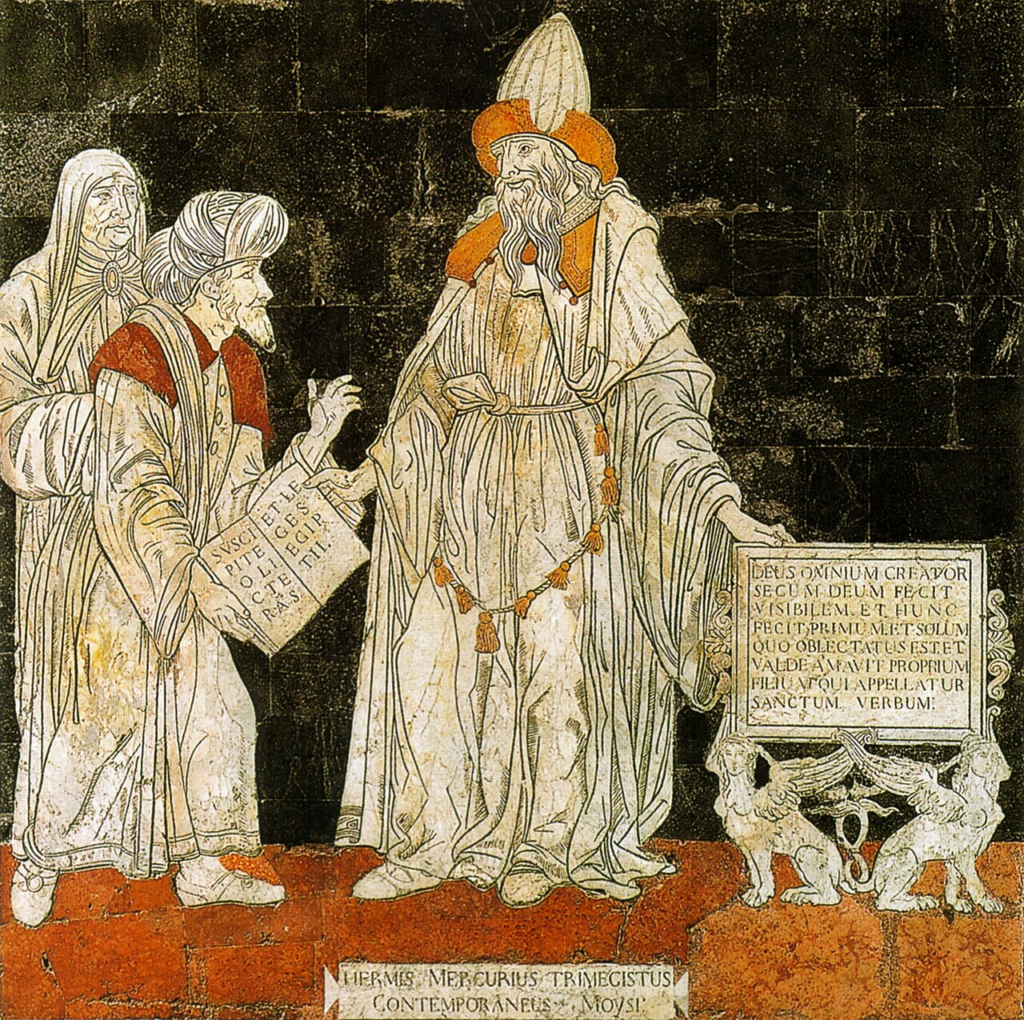
The texts are in Greek and written in Roman Egypt, roughly between the first and third centuries AD. They mix Platonism, Stoicism and Jewish and Egyptian elements. The literary form is that of dialogues in which Hermes instructs a pupil (Tat, Asclepius, Ammon) about God, the kosmos, the soul and its salvation through knowledge. These dialogues are the “philosophical” Hermetica. The astrological, magical and alchemical writings under Hermes’ name are a separate tradition. In 1614 Isaac Casaubon showed on linguistic grounds that the texts were post-Christian, not primeval Egyptian wisdom.
In the Pimander/Poimandres, the narrator falls into a trance and meets an immense being who calls himself Poimandres, “the Mind (Nous) of the sovereign power”. He is shown a vision: boundless light, then a darkness descending, turning into something moist, and turbulent (in greek: physis) that gives off smoke, and from the fire emerges an inarticulate cry. A holy Word (Logos) comes out of the light and settles on that phusis. Then follows the creation of the kosmos, the fall of the primal Man into matter, and the soul’s ascent through the seven planetary spheres. The name Poimandres was read in Greek as “shepherd of men”.
It became popular in the West, when ca. 1460 a Greek manuscript came to Florence, and Marsilio Ficino translated the first fourteen treatises into Latin (dedicated to Cosimo de’ Medici) in 1463; it was printed in 1471 under the title Pimander. In France Lefèvre d’Étaples edited Ficino’s version in 1494 and again in 1505. It circulated in the French humanist milieu (around Clément Marot). François de Foix-Candale published a French Pimandre in 1579. Louis Ménard’s French translation of 1866 was widely read (probably the edition known to Apollinaire).
The line Apollinaire quotes can be found in the first treatise, Poimandrès, in the opening vision (section 4 in the modern numbering). The text describes a frightening, sinuous darkness descending and changing into something of a moist, turbulent nature that gives off smoke like fire, from which emerges a mournful noise. Then comes the sentence Apollinaire refers to: “Puis il en sortit un cri inarticulé qui semblait la voix de la lumière.” The edition is Louis Ménard, Didier et Cie, 1866, pp. 2-16 for this treatise. Hermès Trismégiste (trad. Ménard)/Poimandrès – Wikisource. His wording does not match the translation exactly: the translation begins “Bientôt après descendirent…”, while Apollinaire has “Bientôt … descendirent des ténèbres…” with an ellipsis. That abridged form is Ménard’s own. In his introductory Étude sur l’origine des livres hermétiques, where he compares the Poimandres with the Gospel of John, Ménard quotes the passage shortened, opening “Bientôt descendirent des ténèbres…” and running on to the cry that seemed the voice of light. The same abridged quotation stands in his essay “Les Livres d’Hermès Trismégiste et les derniers jours de la philosophie païenne”. So Apollinaire shortened Ménard’s shortened version: the same opening without “après”, the same ellipsis after “ténèbres”.
—
The French text (Ménard, essay and translation):
- from the introductory essay (comparison with the Gospel of John: And the light shone in the darkness):
« Bientôt descendirent des ténèbres… qui se changèrent en une nature humide et trouble, et il en sortit un cri inarticulé qui semblait la voix de la lumière ; une parole sainte descendit de la lumière sur la nature.
Ce qui en toi voit et entend est le Verbe du Seigneur ; l’Intelligence est le Dieu père.
Je crois en toi et te rends témoignage ; je marche dans la vie et la lumière. Ô Père, sois béni, l’homme qui t’appartient veut partager ta sainteté comme tu lui en as donné le pouvoir. » - from the beginning of the first book Poimandres speaks:
…. À ces mots, il changea d’aspect, et aussitôt tout me fut découvert en un moment, et je vis un spectacle indéfinissable. Tout devenait une douce et agréable lumière qui charmait ma vue. Bientôt après descendirent des ténèbres effrayantes et horribles, de forme sinueuse ; il me sembla voir ces ténèbres se changer en je ne sais quelle nature humide et trouble, exhalant une fumée comme le feu et une sorte de bruit lugubre. Puis il en sortit un cri inarticulé qui semblait la voix de la lumière. Une parole sainte descendit de la lumière sur la nature, et un feu pur s’élança de la nature humide vers les hauteurs ; il était subtil, pénétrant et en même temps actif. Et l’air, par sa légèreté, suivait le fluide ; de la terre et de l’eau il s’élevait jusqu’au feu, d’où il paraissait suspendu. La terre et l’eau demeuraient mêlées, sans qu’on pût voir l’une à travers l’autre, et recevaient l’impulsion de la parole qu’on entendait sortir du fluide supérieur. As-tu compris, me dit Poimandrès, ce que signifie cette vision ? — Je vais l’apprendre, répondis-je. — Cette lumière, dit-il, c’est moi, l’Intelligence, ton Dieu, qui précède la nature humide sortie des ténèbres. La parole lumineuse (le Verbe) qui émane de l’Intelligence, c’est le fils de Dieu. — Que veux-tu dire, répliquai-je ? — Apprends-le : ce qui en toi voit et entend est le Verbe, la parole du Seigneur ; l’Intelligence est le Dieu père. Ils ne sont pas séparés l’un de l’autre, car l’union est leur vie. — Je te remercie, répondis-je. — Comprends donc la lumière, dit-il, et connais-la.
The English text (tr. Everard, 1650)
Then said I, Who are Thou? I am, quoth he, Poemander, the mind of the great Lord, the most mighty and absolute Emperor: I know what thou wouldst have, and I am always present with thee. Then I said, I would learn the things that are, and understand the nature of them, and know God. How? said he. I answered that I would gladly hear. Then said he, Have me again in they mind, and whasoever though wouldst learn, I will teach thee.
When he had thus said, he was changed in his Idea or Form, and straightway, in the twinkling of an eye, all things were opened unto me. And I saw an infinite sight, all things were become light, both sweet and exceeding pleasant; and I was wonderfully delighted in the beholding it. But after a little while, there was a darkness made in part, coming down obliquely, fearful and hideous, which seemed unto me to be changed into a certain moist nature, unspeakably troubled, which yielded a smoke as from Fire; and from whence proceeded a voice unutterable, and very mournful, but inarticulate, inasmuch as it seemed to have come from the Light. Then from that Light, a certain holy Word joined itself unto Nature, and outflew the pure and unmixed Fire from the moist nature upwards on high; it was exceeding Light, and sharp, and operative withal. And the Air, which was also light, followed the Spirit and mourned up to Fire (from the Earth and the Water), insomuch that it seemed to hang and depend upon it.