
Original Notes by Jos van Immerseel – CBS 73554
English
[author: Jos van Immerseel, 1976]
WHY THIS RECORDING?
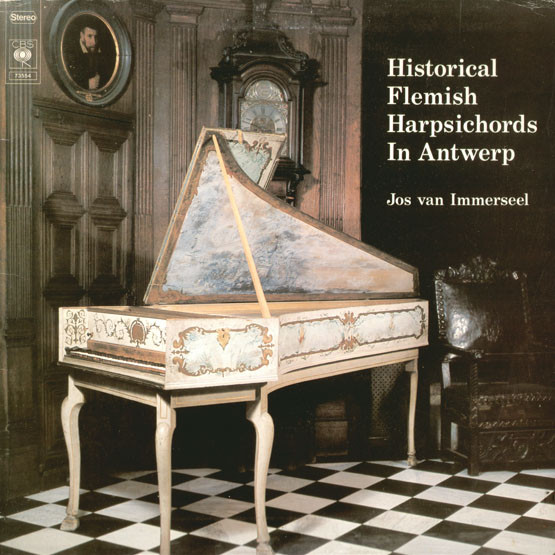
In the 17th and 18th century Antwerp was an Important centre of harpsichord making. The workshops of the Ruckers-dynasty and Dulcken flourished on the highest level. The instruments of the Antwerp workshops were worldwide appreciated and now in our modern times they are copied in very large quantities. Today [1976, ed.] it looks like Antwerp will become a centre of harpsichord-culture.
Indeed the antiquarian museum “Vleeshuis” contains a rich collection of historic harpsichords from Antwerp workshops (Hans II Ruckers, Andreas I Ruckers, Ioannes Couchet, Ioannes Daniel Dulcken, Jacobus van den Elsche, Ioannes Petrus Bull), 9 in total, of which two lent by the Koninklijk Vlaams Muziek-conservatorium of Antwerp. Thanks to the efforts of the Ruckers Society and of the Adjunct-custodian Jeannine Lambrechts-Douillez these instruments are restored systematically by Hubert Bédard in Paris and brought to the attention of builders, players and public. On these, at the time of the recording three instruments, concerts are regularly being given, whereas on the occasion of the yearly summer-course (Kenneth Gilbert) and the harpsichord-course of the Conservatoire (Jos Van Immerseel) they are involved as a historic starting point. This too made the harpsichord-course at the Conservatoire develop into an international attraction in the field of historical interpretation. With the cooperation of the Ministry of Dutch Culture, Monuments and Landscape Service, and the Ruckers Society this recording has been made, a recording which presents three important Antwerp harpsichords played by an Antwerp harpsichord-player and realized at the “Ruckers Headquarters”.
THE RECORDING.
With this recording an attempt has been made to give an authentic image of the sound of the instruments as can be listened to in the Museum “Vleeshuis”. Because the three instruments are placed in different rooms, a level-deviation arose which was deliberately maintained. Technical imperfections not due to the quality of the instruments but simply to their old age have not been eliminated, for instance background noises of the action, particularly with the virginal, and small defects in the regulation. The recording itself went on very folkloristic: the museum is situated in the centre of the town and the cars, the carillon, the harbour noises and the warbling of the birds were accepted with a smile, by the performer as well as by the recording-team, as bringing together these valuable instruments was worthwhile.
THE HARPSICHORD MAKERS.
Ioannes Couchet (ca. 1611-1655) was the grandson of Hans I Ruckers from his mother’s side. About 1627 he started serving his apprenticeship with Hans II Ruckers and in 1642 he was received into the St. Lucas guild and continued the Ruckers-workshop. Only a few instruments of Couchet have been preserved and his 1650-virginal is the only one left. Ioannes Daniel Dulcken (1706-1757) was born in North-Rhine Westphalia, lived in Maastricht, but operated mainly in Antwerp (from 1738 onwards). As of 1764 his son Joannes worked some years in Brussels. He built harpsichords on the highest level and about ten instruments are preserved which can be attributed to him for certain. Ioannes Petrus Bull seems to be educated in the Dulckenworkshop. According to Burney he was one of the most important harpsichord makers of his time. Four instruments are left from Bull, a.o. two at the Conservatoire in Brussels and one in the “Vleeshuis”.
THE INSTRUMENTS.
a) The Couchet virginal.
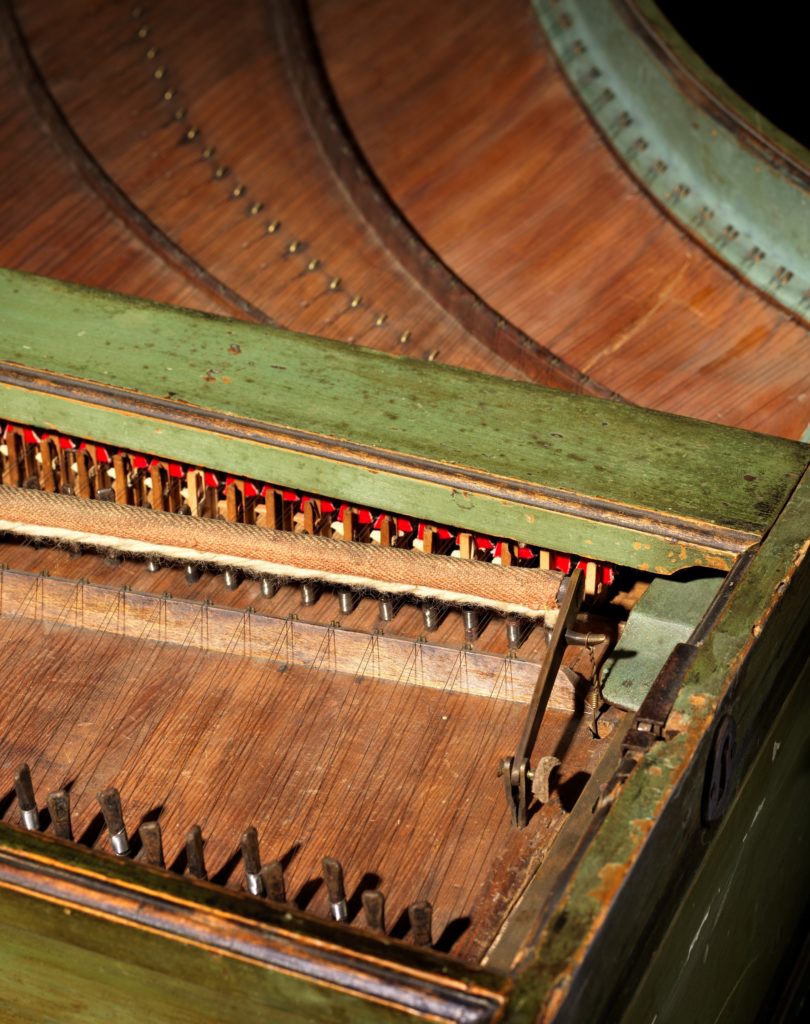
The jackrail bears the inscription “Ioannes Couchet fecit Antverpiae” and on the soundboard the year 1650. The keyboard with 45 keys (E-c”) has a short octave (EC, Fis D, GisE). This instrument is a virginal of the Muselaer-type, with the keyboard at the right and the plucking-point practically in the middle of the string, which gives a warm, dark and splendid sound, but unfortunately also a lot of background noise in the bass-strings. Therefore not all kinds of music can be performed on this instrument. Dance tunes, simple folksong and psalm-arrangements have probably been played on it and these are the most suitable pieces for this instrument. On the inner side of the lid a picture has been painted with a view on Antwerp from the left Scheldt-bank. The virginal was bought in 1967 and restored in 1970. Measurements are 171 x 50 cm.
b) The Dulcken harpsichord.
This instrument has been at the Antwerp Conservatoire since 1941 already. In 1967 it was lent to the “Vleeshuis”. It was restored in 1971. The nameboard-batten bears the wording “Ioannes Daniel Dulcken fecit Antverpiae anno 1747”. The instrument is 2,48 m in length and has 61 keys, three rows of strings (2×8, 1×4′) and three rows of jacks. Remarkably is the double bentside.
c) The Bull harpsichord.
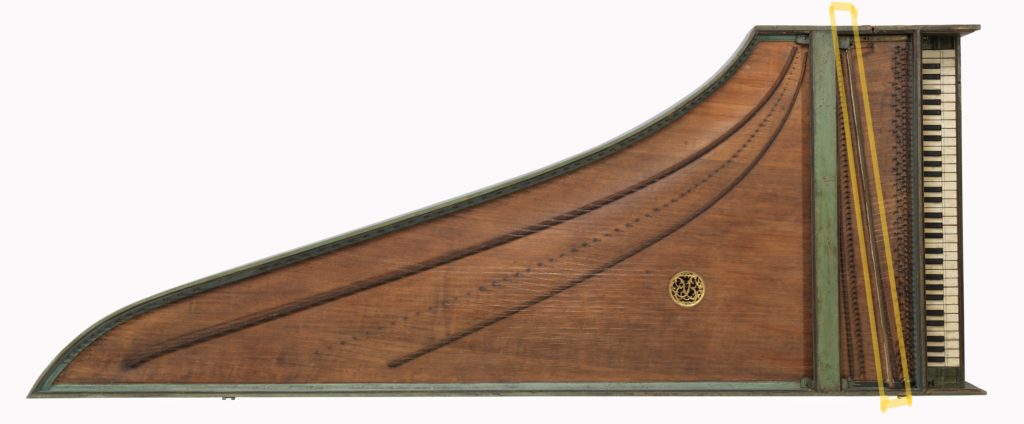
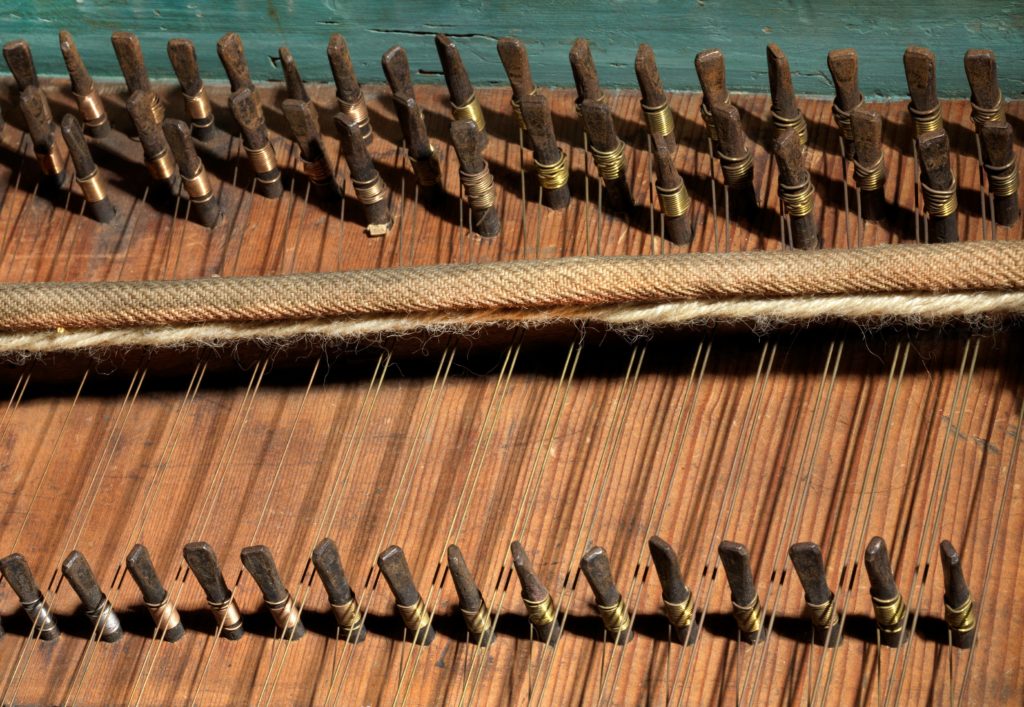
This harpsichord belonged to the town of Antwerp before 1876 already. After being kept at the “Steen” for some time, it was carried to the “Vleeshuis” in 1952. The nameboard-batten bears the inscription “Ioannes Petrus Bull me fecit Antverpiae anno 1779”. The instrument is 2,49 m in length and has 61 keys, three rows of strings (2 x 8′ and 1×4′), three rows of jacks, but four stops. The jacks of one 8 footstop have two jack-tongues, of which the first one with the quills of Delrin is turned to the treble, whereas the other one with the peau de buffle-quill is turned to the bass. A knee-lever can put into operation the peau de buffle-stop, eliminating all other stops. A second knee-lever drops an iron bar with felt coated on both 8-footstrings: a remarkable kind of buff-stop.
d) Tuning.
The virginal has been tuned in the mean-tune, whereas both harpsichords have been tuned in a “baroque” unequal temperament, which although based on the Werckmeiste-rwritings has been somewhat adapted to the program.
THE MUSIC.
a) On the Bull-harpsichord.
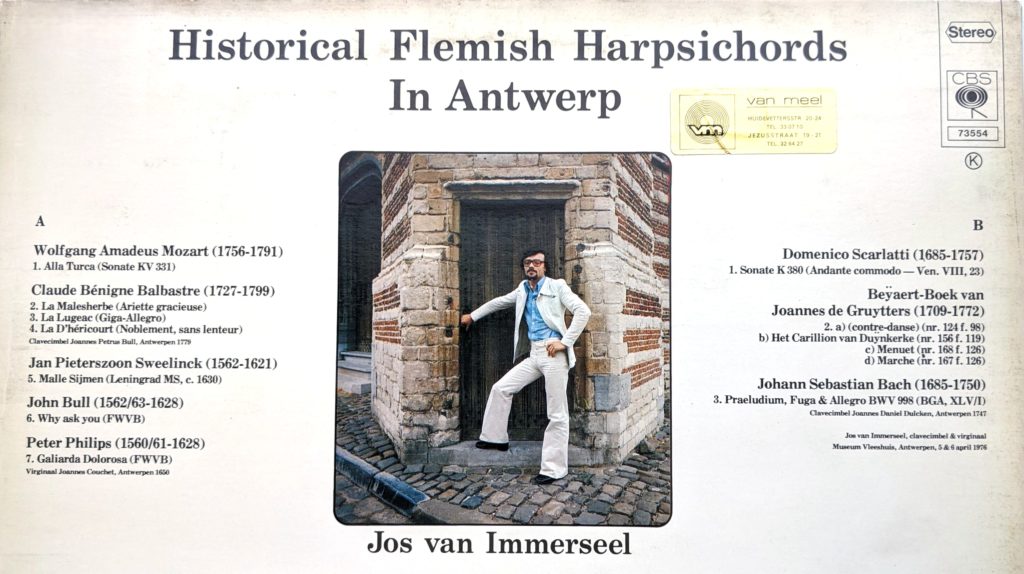
The Alla turca, probably composed in Paris in 1778 therefore during the build of the Bull-harpsichord is from the Sonata in A Major. This piece is one of the hundreds of miniatures written in that period after the Turkish fashion. The Bull sound-idiom lends itself extremely well for this purpose: drum-basses and a bell-treble.
[EXTRA INFO – Dick Wursten: The buff-stop is used to create the contrast. The buff-stop is a register, where the strings are muted very close to the nut by strips of felt, leather or linen, producing a plucked effect. The register is sometimes called a harp-stop.
Balbastre was born in Dijon and studied with Rameau in Paris. In 1756 he was an organist at St. Roch’s, later on (1760) at the Notre Dame. In 1759 he published his book of harpsichord pieces, from which we are playing three pieces which qua character are completely different. La Malesherbe (Ariette gracieuse) could be an Andante by the young Mozart. It renders the gallant but decadent atmosphere of Paris at that time. La Lugeac shows nuances one could call preromantic, whereas La d’Héricourt together with La Forqueray by Duphly one of the most beautiful pieces. of the French harpsichord-repertoire completely exploits the sonorous possibilities of the instrument. Here a master is speaking who with limited means achieves a maximum of sonority and expression.
Balbastre was very popular as a composer as well as an improvisator, to the extent that people streamed towards his concerts in crowds. Some people got completely beside themselves when listening to “le maître”, which in 1762 and 1776 made it necessary to take measures “à cause des désordres dans l’église”.
b) On the Couchet-virginal.
The three pieces were written by composers who worked in the Low Countries and were acquainted with the Antwerp virginals. “Malle Sijmen” is a corruption of “Moll Symes”, an English dance-tune which was transmitted in a large number of versions from the 17th century. John Bull was a highly respected composer in England already when he was appointed organist at the Antwerp Cathedral in 1617. The theme “Why ask you” was varied by him in several versions. We have chosen the perhaps most elegant version from the Fitzwilliam Virginal Book. Peter Philips, also an Englishman by birth, lived in Antwerp from 1590 till 1597, where he was a teacher and published the greater part of his vocal music with Phalesius. The “Galiarda dolorosa” shows the typical Gaillarde-structure: three parts in which every part is repeated with ornaments. In the third part especially the chromatic is striking and is clearly underlined by the tuning of the meantone. At the end of this piece Philips makes a brilliant use of the short octave. In the left hand (visually) chromatic octaves are played, but octaves and decimes are heard alternately.
c) On the Dulcken-harpsichord.
Scarlatti wrote the greater part of his harpsichord compositions, consisting of 555 Sonatas, for Queen Maria Barbara of Spain. According to her last will Maria Barbara had seven harpsichords, among which one Flemish instrument with three stops. One of the most popular Sonatas is K 380, which reveals Scarlatti’s coloration extremely well.
Ioannes de Gruytters was probably born in Ieper. In 1740 he simultaneously became a carillon-player of the cathedral and of the town-carillon. He also distinguished himself as an organist and as a violinist.
In 1746 (one year before the build of the Dulcken-harpsichord) he published a voluminous manuscript with 194 compositions by Vivaldi, Locatelli, Couperin and numerous others.
In this manuscript, which is in possession of the library of the Antwerp Conservatoire since 1922, there are many gallantries such as can be found in collections from the 18th century, as for instance the famous “Notenbüchlein” from Anna Magdalena Bach. In the “Carillion van Duijnkerke” we recognize the folktune “Een kalemanden rok”
The last work is the “Prelude, Fugue and Allegro” by J. S. Bach. It is not sure whether this has been written for harpsichord, lute or Lautencembalo. For the interpretation we have mainly been guided by the principles of the “Figuren und Affektenlehre”, principles which play an important part with Bach’s compositions.
Translation Gerard Van Den Elsaker
Nederlands
WAAROM DEZE OPNAME?
Antwerpen was in de 17d en 18de eeuw een belangrijk centrum van de clavecimbelbouw. De ateliers van de Ruckers-dynastie en van Dulcken hebben hier gefloreerd op het hoogste niveau. De instrument uit de Antwerpse aeliers werden over heel de wereld geapprecieerd, en worden nu – in onze ‘moderne’ tijd – in onwaarschijnlijk grote hoeveelheden nagebouwd. Was het Antwerpen van die dagen een centrum van clavecimbelateliers, het Antwerpen van vandaag belooft een centrum van clavecimbelkultuur te worden. Het oudheidkundig museum Vleeshuis herbergt inderdaad een rijke collectie historische clavecimbels uit Antwerpse ateliers (Hans II Ruckers, Andreas I Ruckers, Ioannes Couchet, Ioannes Daniel Dulcken, Jacobus Van Den Elsche, Joannes Petrus Bull), 9 in totaal, waarvan 2 in bruikleen van het Koninklijk Vlaams Muziekconservatorium van Antwerpen. Door de inspanningen van het Ruckersgenootschap en van adj. conservator Jeannine LambrechtsDouillez worden deze instrumenten systematisch gerestaureerd door Hubert Bédard uit Parijs en onder de aandacht van bouwers, spelers en publiek gebracht. Op de gerestaureerde instrumenten (3) op het moment van de opname) worden ook regelmatig concerten gegeven, terwijl ze tevens als historisch uitgangspunt betrokken worden bij de jaarlijkse zomercursus (Kenneth Gilbert) en bij de clavecimbelcursus van het Conservatorium (Jos van Immerseel). Mede hierdoor ontwikkelde de clavecimbelcursus aan het Conservatorium zich in zeer korte tijd tot een internationale trekpleister op het gebied van de historisch gerichte interpretatie. Met medewerking van het Ministerie van Nederlandse Cultuur, dienst Monumenten en Landschappen en van het Ruckersgenootschap kwam deze plaat tot stand, die drie belangrijke Antwerpse clavecimbels voorstelt, bespeeld door een Antwerps clavecinist en opgenomen in het “Ruckershoofdkwartier”.
DE OPNAME
Bij deze opname werd getracht een zo getrouw mogelijk beeld te geven van de klank van de instrumenten, zoals men ze momenteel in het Museum Vleeshuis kan beluisteren. Doordat de drie instrumenten in verschillende ruimten op gesteld staan, ontstond er een niveauverschil, dat opzettelijk behouden bleef. Technische onvolkomenheden, die niet te wijten zijn aan de kwaliteit van de instrumenten, maar eenvoudigweg aan hun hoge ouderdom bij de restauratie heeft men nl. getracht zo weinig mogelijk te wijzigen werden niet weggewerkt. Zo zijn er hier en daar bijgeluiden van de mechaniek waar te nemen, vnl. bij het virginaal, en kleine mankementen op het gebied van de toonrepetitie. Het museum ligt in volle centrum en het autoverkeer, de beiaard, het havengetoeter en het vogelgekweel zorgden voor de nodige leute. Maar door interpreet en opnameteam werden deze nadelen met de glimlach aanvaard. Het voor de eerste keer samenbrengen van deze waardevolle instrumenten maakte dat overwaard.
DE INSTRUMENTENBOUWERS.
Ioannes Couchet (c.16111655) was langs moederszijde de kleinzoon van Hans I Ruckers en dus de neef van Andreas I en Hans II. Bij deze laatste ging hij omstreeks 1627 in de leer. In 1642 werd hij opgenomen in de St. Lucasgilde. Hij zette het Ruckersatelier voort. Momenteel zijn er slechts enkele instrumenten van Couchet bewaard gebleven. Het 1650-virginaal is het enige virginaal dat van hem rest. Ioannes Daniel Dulcken (1706-1757) werd Noord-Rijn Wesfalen geboren, leefde kort in Maastricht, maar moet rond 1738 in Antwerpen aangekomen zijn, waar hij zijn voornaamste werkterrein vond. Vanaf 1764 werkte zijn zoon Johannes nog enkele jaren in Brussel. Dulcken bouwde clavecimbels op het hoogste niveau en er zijn momenteel nog een tiental instrumenten bewaard, die hem met zekerheid kunnen toegeschreven worden. Ioannes Petrus Bull zou in het atelier van Dulcken opgeleid zijn. Volgens Burney was hij één der belangrijkste bouwers van zijn tijd. Van Bull zijn er vier instrumenten overgebleven, w.o. 2 in het Conservatorium van Brussel en 1 in het Vleeshuis.
DE INSTRUMENTEN.
a) Het Couchetvirginaal.
Op de dokkenlat vindt men de inscriptie “Ioannes Couchet fecit Antverpiae”. Op het zangblad de datum 1650. Het klavier van 45 toetsen (Ec”) heeft een kort oktaaf (E=C, Fis=D, Gis E). Dit instrument is een virginaal van het Muselaertype, met het klavier rechts en het aanslagpunt vrijwel in het midden van de snaar, wat een warme, donkere en prachtige toon geeft maar helaas ook veel bijgeluiden bij de bassnaren. Om die reden kan het instrument niet voor alle muziek dienstig zijn. Naast danswijsjes, klinken eenvoudige volkslied en psalmbewerkingen er het best op en zijn er wellicht het meest op gespeeld. Op de binnenzijde van het dekblad vindt men een schilderij met zicht op Antwerpen, vanaf de Scheldelinkeroever. Het virginaal werd in 1967 aangekocht en in 1970 gerestaureerd. Afmetingen: 171 x 50 cm.
b) Het Dulckenclavecimbel.
Dit instrument is reeds sinds 1941 in het Conservatorium van Antwerpen. In 1967 werd het in bruikleen afgestaan aan het museum Vleeshuis. Het werd in 1971 gerestaureerd. De lat boven het klavier vermeldt: Ioannes Daniel Dulcken fecit Antverpiae anno 1747. Het instrument, dat 2,48 m lang is, heeft een klavier van 61 toetsen, 3 reeksen snaren (2×8, 1×4′) en drie dokkenreeksen. Merkwaardig is de dubbele wand aan de gebogen zijde.
c) Het Bullclavecimbel. Dit clavecimbel was reeds vóór 1876 in het bezit van de stad Antwerpen. Na een tijd in het Steen bewaard te zijn, werd het in 1952 overgebracht naar het Vleeshuis. Het werd in 1973 gerestaureerd. De lat boven het klavier vermeldt: Ioannes Petrus Bull me fecit Antverpiae anno 1779. Het instrument is 2,49 m lang en bevat 61 toetsen, drie reeksen snaren (2 x 8′, 1 x 4′), drie reeksen dokken maar evenwel 4 registers. De dokken van 1 achtvoetsregister bevatten twee tongetjes, waarvan datgene met Delrin-plectrum naar de diskant gekeerd staat, terwijl het andere met Peau-de-buffleplectrum naar de baskant wijst. Een kniehefboom kan dit Peau-de-buffleregister inschakelen, terwijl het alle andere registers automatisch annuleert (machine). Een tweede kniehefboom laat een ijzeren staaf, die met stof overtrokken is, neer op de beide achtvoetssnaren: een merkwaardig soort luitregister.
d) Stemming. Het virginaal werd in middentoon gestemd, terwijl de beide clavecimbels gestemd werden in een “barokke” ongelijkzwevende temperatuur, die alhoewel gebaseerd op de geschriften van Werckmeister, naargelang het programma enigszins aangepast werd.
DE MUZIEK.
a) Op het Bullclavecimbel. De Alla turca, waarschijnlijk in 1778 gekomponeerd in Parijs dit is dus tijdens het bouwen. van het Bullclavecimbelkomt uit de Sonate in A. Het stuk is een van de honderden miniatuurtjes, die in die periode naar de turkse mode geschreven werden. Het Bullklankidioom leent zich hier uitstekend toe: trommelbassen en een belletjesdiskant.
EXTRA: in het ‘zachte’ middendeel wordt de buff-stop gebruikt. Een register waarbij de snaren vlakbij de stemblok-kam afgedempt worden door strookjes vilt, leder of linnen, waardoor een specifiek tokkeleffekt ontstaat.
Balbastre werd geboren te Dijon, maar kwam te Parijs bij Rameau studeren. In 1756 vinden. we hem als organist aan St. Roch, later (1760) aan de NotreDame. In 1759 verschijnt zijn. boek clavecimbelwerken, waaruit we drie stukken spelen, die qua karakter volledig uiteenlopend zijn.
La Malesherbe (Ariette gracieuse) lijkt wel een Andante van de jonge Mozart te zijn. Het ademt de galante, maar dekadente salonsfeer van het toenmalige Parijs. La Lugeac vertoont wendingen en kleuren die men preromantisch zou kunnen noemen, terwijl La d’Héricourt met “la Forqueray” van Duphly één der mooiste stukken uit het Franse clavecimbelrepertoire de sonore mogelijkheden van het instrument ten volle uitbuit. Hier is een meester aan het woord, die met beperkte middelen een maximum aan klankrijkdom en expressiviteit weet te bereiken.
Balbastre was als komponist en improvisator zo populair, dat het volk in dichte drommen naar hem toestroomde. Sommigen geraakten buiten zichzelf bij het beluisteren van “le maitre” en het was blijkbaar dan ook nodig in 1762 en 1776 maatregelen te nemen “à cause des désordres causés dans l’eglise”.
b) Op het Couchetvirginaal.
De drie stukken werden geschreven door komponisten die in de lage landen gewerkt hebben en de virginalen uit de Antwerpse school gekend hebben. Malle Sijmen is een verbastering van Moll Symes, een Engelse danswijze die in tal van versies uit de 17de eeuw overgeleverd werd. John Bull was in Engeland reeds een komponist van hoog aanzien toen hij in 1617 organist aan de Kathedraal te Antwerpen werd.
Het thema “Why ask you” werd door hem ‘in verschillende versies gevarieerd. Wij kozen de kleinste, maar misschien de bekoorlijkste, die in het Fitzwilliam Virginal Book voorkomt. Peter Philips,ook Engelsman van geboorte, verbleef van 1590 tot 1597 te Antwerpen, waar hij een lespraktijk opbouwde en ook het grootste gedeelte van zijn vokale muziek bij Phalesius. liet publiceren. De Galiarda Dolorosa vertoont de typische Gaillardeopbouw: drie delen, waarbij elk deel versierd herhaald wordt. In het derde deel is vooral de kromatiek opvallend, nog duidelijker onderstreept door de middentoonstemming. Op het einde van het stuk maakt Philips geniaal gebruik van het kort oktaaf. In de linkerhand speelt men (visueel) kromatische oktaven, maar men hoort afwisselend oktaven en deciemen.
c) Op het Dulckenclavecimbel.
Voor Koningin Maria Barbara van Spanje schreef Scarlatti het grootste gedeelte van zijn clavecimbelwerk, dat 555 sonates omvat. Volgens haar testament bezat Maria Barbara zeven clavecimbels, waaronder een vlaams instrument met drie registers. De Sonate K 380 is één van de populaire sonates, die Scarlatti’s koloriet uitstekend reveleren.
Ioannes de Gruytters zou geboren zijn in Ieper. In 1740 wordt hij gelijktijdig beiaardier van de kathedraal (op de kapittelbeiaard) en van de stad (op de kermisbeiaard). Ook als organist en als violist wist hij zich te onderscheiden. In 1746 (een jaar voor de bouw van het Dulckenclavecimbel) dateerde hij een lijvig handschrift waarin 194 werken voorkomen van Vivaldi, Locatelli, Couperin en talrijke anderen. In het handschrift, dat sinds 1922 in de bibliotheek van het Conservatorium van Antwerpen berust, vinden we ook tal van galanteriën zoals we die in verzamelingen uit de 18de eeuw vinden. Denken we maar aan het beroemde boekje van Anna Magdalena Bach. In het Carillion van Duijnkerke herkennen we de volksliedmelodie “Een kalemanden rok”.
Van J. S. Bach tenslotte speelden we het Preludium, Fuga en Allegro, waarvan het niet zeker is of het voor clavecimbel, luit of Lautencembalo geschreven is. Bij de interpretatie hebben wij ons hoofdzakelijk laten leiden door de principes van de figurenleer en de affektenleer, principes die in het werk van Bach een zeer grote rol spelen.
Jos van Immerseel
Français
1. POURQUOI CET ENREGISTREMENT?
Au 17ème et 18ème siècle, Anvers était connu comme un centre important de facture de clavecin. Les ateliers des dynasties Ruckers et Dulcken dominaient ce marché. Les instruments des ateliers anversois étaient appréciés dans le monde entier. Aujourd’hui, on construit partout des copies en très grand nombre. Si Anvers était jadis le centre des ateliers de facture de clavecin l’Anvers d’aujourd’hui promet de devenir le centre de la culture du clavecin. Le musée historique “Vleeshuis” abrite effectivement une collection importante d’anciens clavecins des ateliers anversois (Hans II Ruckers, Andreas I Ruckers, Ioannes Couchet, Ioannes Daniel Dulcken, Jacobus Van Den Elsche, Ioannes Petrus Bull), 9 au total, dont 2 prétés par le “Koninklijk Vlaams Muziekconservatorium” d’Anvers. Grâce aux efforts de l’association Ruckers et du conservateuradjoint, Jeannine Lambrechts-Douillez, ces instruments ont pu être restaurés par Hubert Bédard de Paris et ont ainsi attiré l’attention des constructeurs, des musiciens et du public. Des concerts sont encore régulièrement donnés sur les instruments restaurés (trois au moment de l’enregistrement).
Ces instruments servent également comme sujet historique des cours d’été annuels de Kenneth Gilbert et des cours de clavecin de Jos van Immerseel au Conservatoire. Ce disque qui présente trois clavecins d’Anvers joués par un claveciniste anversois, est enregistré dans le “Centre Ruckers” en collaboration avec le Ministère de la Culture Néerlandaise, Commision Royale des Monuments et Sites et de l’Association Ruckers.
2. L’ENREGISTREMENT.
Lors de l’enregistrement on a cherché à reproduire les sons des clavecins aussi fidèlement que possible, tel qu’on peut les écouter au Musée “Vleeshuis”. Du fait que les trois instruments ont été mis à trois endroits différents, il estapparu une différence ce niveau qui a été conservé volontairement.Les imperfections techniques, qui ne sont pas dû à la qualité des instruments mais simplement à leur âge, ne sont pas éliminées, puisque à la restauration on a essayé d’altérer le moins possible les instruments originaux. Ainsi on remarque parfois des bruits mécaniques (par example au virginal) et des petits. défauts à la régulation. Le musée se trouve en plein centre d’Anvers et le traffic, le carillon, les bruits du port et les chants d’oiseaux ont été acceptés par l’artiste et toute l’equipe technique. Le fait que ces trois instruments soient rassemblés pour la première fois doit les faire entièrement oublier.
3. LES FACTEURS D’INSTRUMENTS.
Ioannes Couchet (c. 1611-1655) était par sa mère le petitfils de Hans I Ruckers et donc le neveu d’Andreas I et Hans II il devint apprentit vers 1627 chez ce dernier. En 1642 il fut affilé à la corporation de St.Luc. Il continua l’atelier Ruckers. Actuellement il n’y a plus que quelques instruments de Couchet qui ont été conservés. Le virginal 1650 est le seul virginal qui lui reste. Ioannes Dulcken (1706-1757) est né à Rhénanie-du-Nord-Westphalie, mais serait arrivé à Anvers en 1738, où il trouva son terrain de travail le plus important. A partir de 1764 son fils Joannes, travailla encore quelques années à Bruxelles. Dulcken båtit des clavecins du plus. haut niveau et actuellement il existe encore une dizaine d’instruments qu’on peut lui attribuer.
Ioannes Petrus Bull aurait été formé à l’atelier de Dulcken. Selon Burney il fut un des constructeurs les plus importants de son époque. Il y a 4 instruments de Bull qui sont conservés, entre autres 2 au conservatoire de Bruxelles et un au “Vleeshuis” d’Anvers.
4. LES INSTRUMENTS.
a) Le Virginal Couchet.
Sur le chapiteau on trouve l’inscription “loannes Couchet fecit Antverpiae”, sur la table, la date 1650. Le clavier de 45 touches (Ec”) a une octave courte (EC, Fis D, GisE). Cet instrument est un virginal du type Muselaer, avec à droite le clavier et le point d’attaque à peu près au milieu de la corde, ce qui donne un ton chaud et beau mais malheureusement aussi beaucoup de bruits parasites dans les cordes de basse. Pour cette raison, l’instrument ne peut être utilisé pour n’importe quelle musique. Des airs de danse, de simples adaptions de chansons. populaires et de psaumes donnent le meilleur effet sur le virginal et sont probablement le plus souvent joué sur cet instrument. Au verso du couvercle on voit un tableau d’une vue d’Anvers, à partir de la rive gauche de l’Escaut. Le virginal a été acheté en 1967 et il a été restauré en 1970. Mesures: 171 x 50 cm.
b) Le Clavecin Dulcken.
Cet instrument est déjà depuis 1941 au conservatoire d’Anvers. En 1967 il a été prêté au musée “Vleeshuis”. Il a été restauré en 1971. La barre d’adresse mentionne: Ioannes Daniel Dulcken fecit Antverpiae anno 1747. L’instrument, qui a une longueur de 2,48 m., a un clavier de 61 touches, 3 séries de cordes (2×8′, 1×4′) et trois rangs de sautereaux. La double éclisse à la courbe est assez remarquable.
c) Le Clavecin Bull.
Ce clavecin fut déjà en la possession de la ville d’Anvers avant 1876. En 1952 il a été transporté au Vleeshuis. Il fut restauré en 1973. La barre d’adresse mentionne: “Ioannes Petrus Bull me fecit Antverpiae anno 1779”. L’instrument a une longueur de 2,49 m, et contient 61 touches, 3 séries de cordes (2×8′, 1×4′), 3 séries de sautereaux mais cependant 4 régistres. Les sautereaux d’un jeu de 8 pieds comprennent deux languettes. La languette au plectre Delrin est tourné vers l’aigu, tandis que l’autre au plectre en Peau de Buffle est tourné vers le grave. Une genouillère peut brancher le jeu Peau de Buffle, tandis qu’il annule tous les autres jeux automatiquement. Une seconde genouillère fait descendre une barre en fer qui est revêtue de tissu sur les cordes des jeux de 8 pieds un remarquable jeu de luth.
d) Tempérament.
Le virginal est accordé en “meantone” tandis que les deux clavecins sont accordés dans un tempérament baroque inégal qui, bien que basé sur les traités de Werckmeister a été plus ou moins adapté selon le programme.
5. LA MUSIQUE.
a) Sur le clavecin Bull.
L’Alla turca de Mozart, probablement composé en 1778 à Paris c.a.d. pendant la construction de clavecin Bullest extrait de la sonate en La Majeur. Le morceau est une des centaines de miniatures qui ont été écrites dans cette période d’après la mode turque. La sonorité de l’instrument se prète facilement à cela: des basses de tambours et des clochettes vers l’aigu. Balbastre est né à Dijon, mais vint étudier à Paris chez Rameau. En 1756 il devint organiste à St. Roch, plus tard (1760) à Notre Dame. En 1759 parait son livre pièces de clavecin duquel sont joués 3 morceaux dont le caractère differe totalement.
On dirait que La Malesherbe (Ariette gracieuse) est une Andante du jeune Mozart. Elle respire l’atmosphère galante mais décadente des salons du Paris de l’époque. La Lugeac expose des tournures et des couleurs. qu’on pourrait nommer préromantiques, tandis que la d’Héricourt avec “La Forqueray” de Duphly, un des plus beau morceaux du répertoire du clavecin français exploite à fond les possibilités sonores de l’instrument. Ici le maitre a la parole qui, avec des moyens limítés, peut atteindre un maximum d’expressivité et de richesse de son.
Balbastre était en tant que compositeur et improvisateur extrèmement populaire à tel points qu’en 1762 et 1776 il fallut prendre des mesures “à cause des désordres causés dans l’église”.
b) Sur le virginal Couchet.
Les trois morceaux ont été écrit par des compositeurs qui ont travaillé aux “Bas Pays” et qui ont connu le virginal de l’école d’Anvers.
Malle Sijmen est un abâtardissement de Moll Symes, une chanson de danse anglaise qui a été fort arrangé au 17ème siècle en plusieurs versions.
John Bull était déjà en Angleterre un compositeur renomé quand il devint organiste à la cathédrale d’Anvers en 1617. Le thème “Why ask you” a été varié par lui en différentes versions. Nous avons choisi la plus petite mais probablement la plus ravissante qu’on rencontre dans le Fitzwilliam Virginal Book.
Peter Philips, lui aussi anglais de naissance, résida de 1590 à 1597 à Anvers où il fit publier la plus grande partie de sa musique vocale chez Phalesius. La Galiarde Dolorosa présente la structure typique d’une Galliarde: chaque des trois parties est varieé dans la reprise.
Dans la 3ème partie surtout le chromatisme est frappant, encore plus clairement souligné par l’ambiance du “meantone”. A la fin du morceau, Philips fait habillement usage de l’octave courte. Dans la main gauche on joue des octaves. chromatiques, mais on entend alternativement des octaves et des dixièmes.
c) Sur le clavecin Dulcken.
Scarlatti a écrit la plus grande partie de son œuvre pour clavecin, qui comprend 555 sonates, pour la reine Marie Barbara d’Espagne. Selon son testament, Marie Barbara possédait sept clavecins, parmi lesquels un instrument flamand à 3 registres. La sonate K 380 est une des sonates populaires qui révèlent parfaitement la couleur de Scarlatti.
Ioannes de Gruytters serait né à Ypres. En même temps il devint en 1740 carillonneur de la cathédrale et de la ville. Il se destingua aussi comme organiste et violoniste. En 1746 (une année avant la construction du clavecin Dulcken) il data un important manuscrit dans lequel figure des œuvres de Vivaldi, Locatelli, Couperin et de nombreux autres. Dans le manuscrit, qui se trouve depuis 1922 au conservatoire d’Anvers, on trouve une quantité de galanteries comme on en trouve dans les collections du 18ème siècle. Pensons au livret connu d’Anna Magdalena Bach.
Dans le carillon Van Duynkerke, nous reconnaissons la mélodie de la chanson populaire “Een kalemanden rok”.
De J. S. Bach enfin, nous jouerons la Prélude, Fugue et Allegro, dont on n’est pas certain qu’il fut écrit pour clavecin, luth ou Lautencembalo. L’interpretation a été guidée par le principe de la Rhétorique musicale, une science et une pratique qui jouent un très grand rôle dans l’œuvre de Bach.