
Faithful English translation from the Latin (ch. VII of Meditationes S. Augustini), 1624
modernised the orthography.
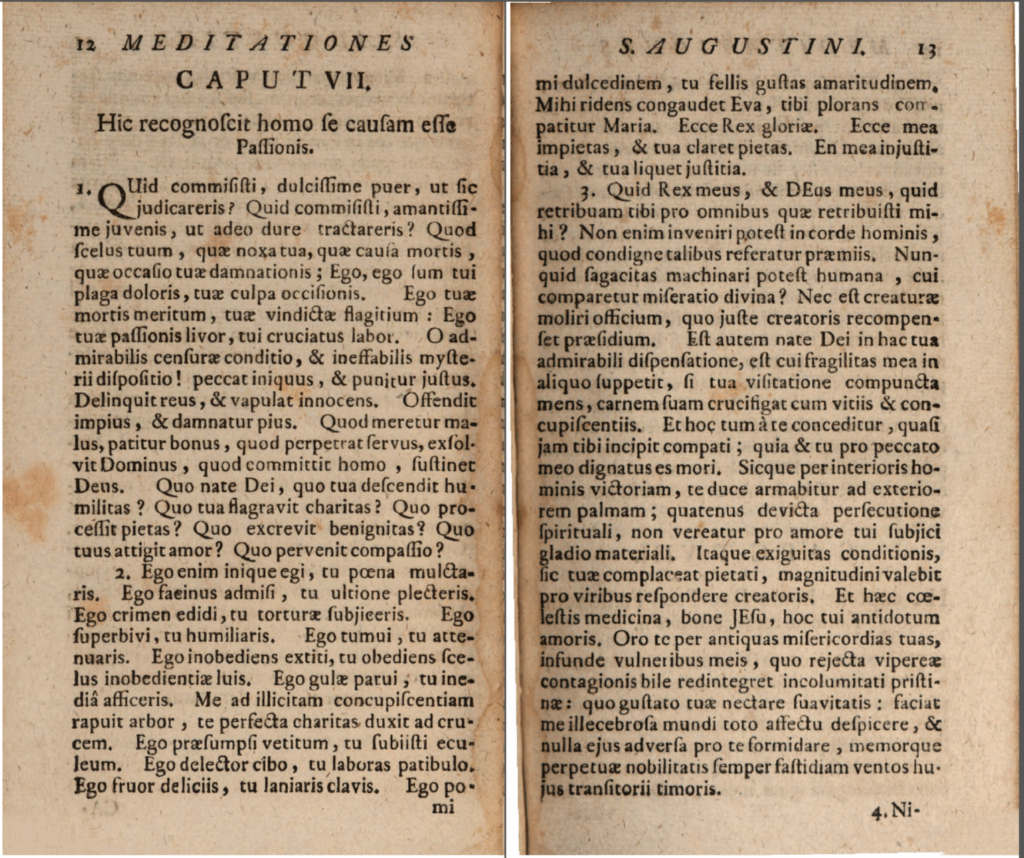
Chapter VII – Hic recognoscit homo se causam esse Passionis
Here man acknowledges himself to have been the cause of Christ’s passion.
What have you done, most sweet child, that you should thus be judged? What have you done, most loving youth, that you should be so cruelly handled? What was your sin, what was your fault, what was the cause of your death, what was the occasion of your condemnation? I am the blow that caused your pain, I am the fault for which you were slain, I am the guilt for which you died, the mischief for which you were treated so cruelly. I am the black and blue strokes of your passion, I am the toil of your torment.
Oh wonderful manner of proceeding, in a matter of judgment and correction! Oh unspeakable disposition, in a mystery unknown! The unjust sins, and the just is punished. The guilty does wrong, and the guiltless is corrected. The ungodly offends, and the godly is condemned. What the wicked deserves, the good suffers. The debt contracted by the servant is discharged by the master. What man does is endured by God. How low, O Son of God, how low has your humility descended? How much has your charity been inflamed? How far has your pity reached? How far has your kindness increased? How far has your love extended? How far has your compassion arrived?
For it is I who have done wrong, and you are condemned. I committed the offense, and you are punished. I am the one who sinned, and you are tormented. I was proud, and you are humbled. I was high-minded, and you are abased. I was disobedient, and you, being obedient, have suffered the pain of my disobedience. I indulged in gluttony and excess, and you are afflicted with abstinence. An inordinate heat violently drew me to unlawful lust, and true charity led you to the cross. I presumed to do what was forbidden me, and you have taken the punishment upon yourself. I delight in eating, and you are tormented on the tree of your passion. I abound in pleasures, and you are pierced with nails. I taste the sweetness of the apple, and you the bitterness of the gall. My mother Eve laughs with me, and your mother, the Blessed Virgin Mary, mourns with you.
Behold, O King of Glory, behold my wickedness, and thereby may clearly be seen your goodness. Behold my injustice, and thereby is made manifest your righteousness. What shall I give you, O my King and my God? What shall I give you for all the benefits you have bestowed upon me? Truly nothing can be found in man’s heart that can balance such a great gift. Can anything possibly be imagined by the wit of man to which the mercy of God may be justly compared? Neither is it the part of a creature to attempt to fully repay the help he has received from his Creator.
However, there is something, O Son of God—by reason of your admirable ordering of all things—there is something in which my frailty may help me somewhat: namely, if my soul, moved by your visitation, becomes contrite and crucifies the flesh together with its sinful affections and desires. So that, when this is granted by you, from that time forward the soul begins to suffer with you, for you have deigned to die for my iniquity. And thus, through the victory of the inner man, it becomes strong and fortified against the outer, having you as its captain and leader. In so much that, having vanquished and overcome all internal persecution, it fears not, for your love, to expose itself to sword or spear. This smallness of my condition, if it be pleasing to your goodness, will—according to my meager strength—resemble the greatness of my Creator.
This heavenly remedy of yours, O good Jesus, this counter-poison or preservative of your charity, I beseech you, by your ancient and accustomed mercies, pour into my wounds, so that all contagion of sin being cast out, it may restore me to my former health. Having tasted the pleasant drink of your sweetness, may I utterly scorn all worldly vanities and fear none of its adversities. And keeping always in mind that eternal excellence, may I always disdain the empty blasts of transitory honor.
Let nothing, I beseech you, be sweet, nothing pleasing, nothing precious to me without you. Let nothing, no matter how fair and beautiful, delight and content me but you. Let all things, I pray you, without you, seem base and filthy to me. Let whatever offends you be displeasing to me, and the fulfilling of your will and pleasure my constant desire. Let it grieve me to be glad without you, and let it be my comfort to be sad for you. Let your holy name be my joy, and the memory of you my consolation. Let my tears in seeking day and night your righteousness be my bread. Let the law of your mouth be my riches and treasure, to be preferred before thousands of gold and silver. Let obedience to you be sweet and delightful to me, and resistance to you hateful and detestable.
I humbly beg you, O my hope, by all your mercies, that you would be pleased to pardon me my iniquities. Open my ears to your commandments, and for your holy name’s sake, I beseech you, do not permit my heart to speak words of malice or excuse my wrongdoings. I ask you likewise, by your wonderful humility, that the foot or affection of pride may not approach me, and that the hand or actions of sinful men may not move or allure me to turn away from you.
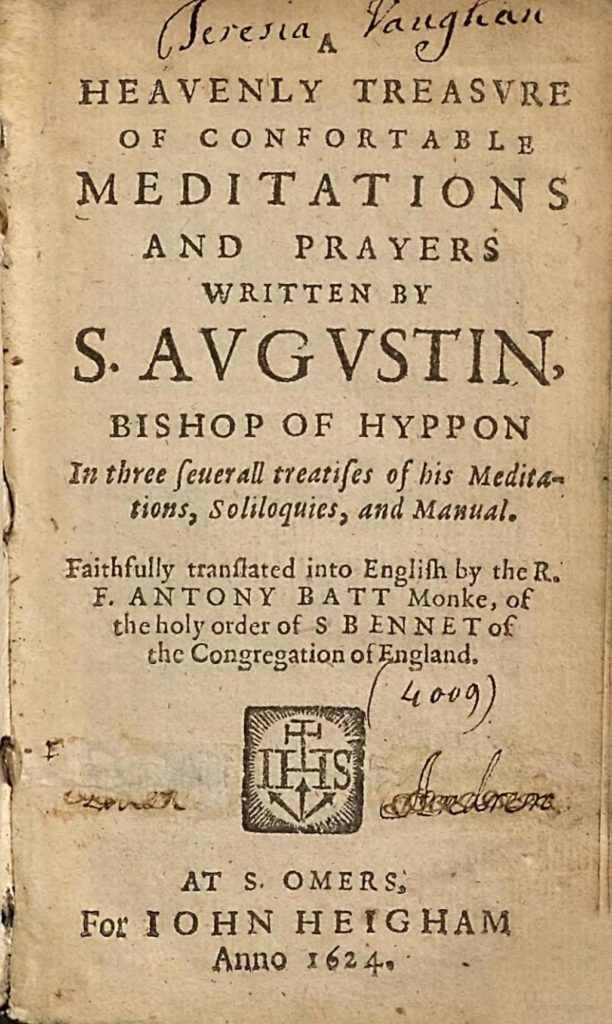
FULL TITLE:
A HEAVENLY TREASURE OF CONFORTABLE MEDITATIONS AND PRAYERS WRITTEN BY S. AUGUSTIN, BISHOP OF HYPPON In three severall treatises of his Meditations, Soliloquies, and Manual. – Faithfully translated into English by the R. F. ANTONY BATT Monke, of the holy order of S BENNET of the Congregation of England. AT S. OMERS, For IOHN HEIGHAM Anno 1624.