
English translation of the last section of an essay by Thomas Synofzik (German)
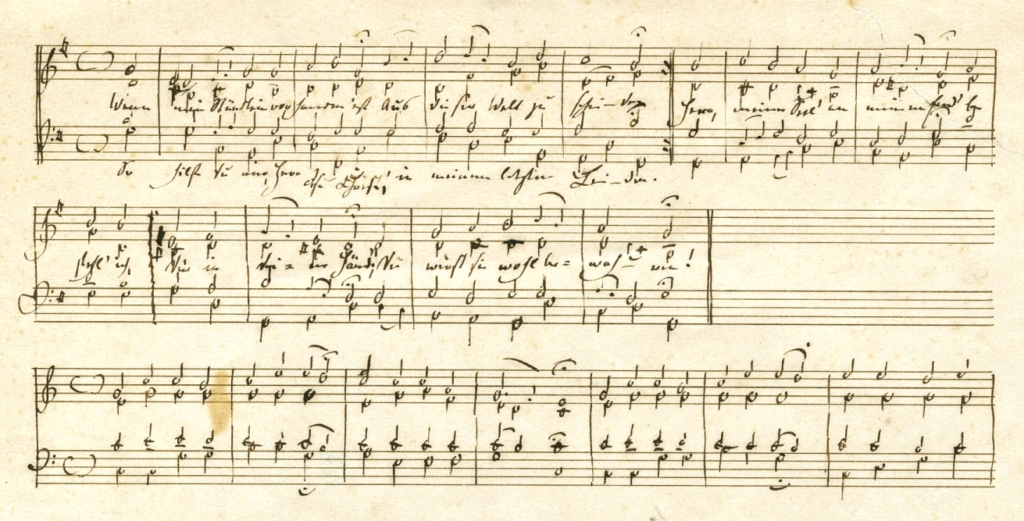
Archiv-Nr. D-Zsch 10963-A1/A3
In late February 1854, Schumann attempted suicide. On 4 March he was admitted to the private psychiatric institution in Bonn-Endenich, where he spent the remaining two and a half years of his life. In September 1854, Schumann requested manuscript paper and in the period that followed was frequently engaged in writing music.1 The last concrete work mentioned is the composition, in January 1856, of a now-lost fugue for piano.2 Apart from an also lost piano reduction of Joseph Joachim’s Overture to Heinrich IV, op. 7, which Schumann presumably began in April 1855,3 only two concrete activities can be identified and are transmitted: the piano accompaniments to Paganini’s Caprices, composed between March and at least September 1855, and two chorale settings, probably dating from the final weeks of his life. In both cases, these are not new original compositions, but choral settings (four voices) to an existing tune.4
The last recorded instance of Schumann playing the piano appears in his medical files on 1 May 1856.5 On 21 June, there is an entry: “Reads in a book which he allows no one to see (probably the Bible),” and on the following day: “Leafs through the Bible while singing[!].” This may indicate that Schumann was occupying himself with church hymns. Since on 26 June Schumann is noted as being “writing again in the former manner,”6 it is possible that the preserved autograph of the Endenich chorales was written during this penultimate month of his life.
The original manuscript of the two chorale settings entered the Robert Schumann House in Zwickau in 1938 from the estate of Robert Schumann’s youngest daughter, Eugenie. The autograph was among the institution’s most valuable exhibition objects and was occasionally used—partially—as an illustration in books.7 It consists of a single sheet ruled with sixteen systems, of which only the upper six are notated. In the seventh and eighth systems clefs are entered, but no notes are written.
The first chorale is fully notated and provided with the text “Wenn mein Stündlein vorhanden ist.” The melody harmonized by Schumann is first documented in Frankfurt am Main in 1569; the text is by Nikolaus Hermann (1500–1561). Below the text. The full song with translation can be found here
| Wenn mein Stündlein vorhanden ist, und ich soll hinfahren meine Strasse, geleite mich, Herr Jesu Christ, mit Hilf mich nicht verlasse: den Geist an meinem letzten End befehl ich, Herr, in deine Händ; du wirst ihn wohl bewahren. | If the hour of my death is at hand And I must travel on my way Accompany me, Lord Jesus Christ, With your help do not abandon me: At my final end my spirit I entrust, Lord, in your hands; You will preserve it well. |
The second chorale has remained a fragment. It breaks off after only seven measures, in the middle of the fourth chorale line. The identification of the unknown chorale melody proved problematic, since no textual indication was present and the total number of chorale lines was also unknown. Thanks to the Saarbrücken musicologist Werner Braun, the melody could be identified as “Stärk uns Mittler, dein sind wir.”8 This chorale no longer appears in modern hymnals. The melody was first published in 1793 with a different text (“confirmation chorale”) and was composed by Justin Heinrich Knecht (1752–1817).9 It was not uncommon for chorales intended for very specific occasions to be supplied with several parallel texts, allowing the melodies to be reused. Accordingly, Knecht published his melody under a double title: “Stärk uns Mittler, dein sind wir” and “Mitten wir im Leben sind.” Knecht’s melody thus served as an alternative to the old Phrygian tune associated with the antiphon Media vita in morte sumus from the eleventh century, translated by Luther as “Mitten wir im Leben sind” (1524). In view of the thematic focus of the first chorale and Schumann’s life circumstances, it is more plausible that Schumann had this text in mind when setting the melody.
IMHO, this inference is made too readily. The text “Stärk uns, Mittler, dein sind wir” is the form under which the hymn appears in the hymnbooks Schumann may have known. By 1856, the hymn itself was quite common and widely included. The text also corresponds well to Schumann’s situation at the time. (Dick Wursten) – so, I’ll provide that text (Luther’s hymntext, see wiki).
| Stärk uns, Mittler, dein sind wir! Sieh, wir alle flehen: Lass, lass, o Barmherziger, uns dein Antlitz sehen! Wach über unsre Seelen! Hier stehn und sprechen alle wir: Herr, dein Eigentum sind wir! Heiliger Schöpfer, Gott, heiliger Mittler, Gott, heiliger Gott, Lehrer und Tröster, dreieiniger Gott, lass uns nie vergessen unsern teuern, heilgen Bund! Erbarm dich unser! | Strengthen us, Mediator, for we are yours! See, we all implore you: Grant—grant, O Merciful One, that we may behold your countenance! Watch over our souls! Here we stand, and speak as one: Lord, we are your own! Holy Creator, God; holy Mediator, God; holy God, Teacher and Comforter, triune God, let us never forget our precious, holy covenant! Have mercy on us! |
Edition: Thomas Synofzik, Endenicher Sterbechoräle, Edition choris mundi, 2006.
Transcription: IMSLP ;
Dr Thomas Synofzik has been Director of the Robert Schumann House in Zwickau since 2005.
- Bernhard R. Appel (ed.), Robert Schumann in Endenich (1854–1856): Krankenakten, Briefzeugnisse und zeitgenössische Berichte, Mainz 2006.
- Ibid., p. 351.
- Ibid., p. 417.
- Ibid., p. 31.
- Ibid., p. 376.
- Ibid., p. 383.
- Georg Eismann, Robert Schumann. Eine Biographie in Wort und Bild, Leipzig 1956, p. 156; Thomas Synofzik, Briefe und Dokumente im Schumannhaus Bonn-Endenich, Bonn 1993, p. [75].
- Margit McCorkle, Robert Schumann. Thematisch-bibliographisches Werkverzeichnis, Munich 2003, appendix R18.
- Justin Heinrich Knecht, Biberacher Choralbuch mit Choralmelodien im vierstimmigen Originalsatz, ed. Otto Herzog, Fritz Kolesch, and Ralf Klotz, Biberach [2002].